


Food Tips
The best kitchen knives for today's home cook

Food Tips
The best kitchen knives for today's home cook
A good knife can elevate dinner prep from a chore to a pleasure. It’s an investment and treasure that should - with the right care - last a lifetime.
A good knife is also safer to work with than an inexpensive, lightweight, stainless steel job that will rapidly become dull and prone to slipping off foods, resulting in kitchen accidents.
But what makes a good knife? There are a few things to look for, and a few to avoid.
1. The blade
Just say no to stainless steel. Sure, these blades will keep their shine, but will soon lose their edge, and are too brittle to be sharpened. Once they're dull, you might as well throw them away. Look for high-carbon, no-stain steel. These knives will require some care: wash by hand—never run them through the dishwasher—and dry completely as they can rust. Take the time to sharpen them yourself, or have them sharpened by a professional now and then. Talk to your local kitchen supply shop, or inquire about sharpening where you purchased the knife, as many shops that sell knives also offer professional sharpening services.
2. The construction
The best knives boast only a two-part construction: blade and handle. That means, there are fewer, and in some cases, no parts to get loose, fall off, or come unglued. When looking at the knife, your eye should be able to follow the back of the blade, as the blade turns into the tang, uninterrupted, right to the end of the handle. In a poor quality knife, the blade may only extend a few inches into the handle, and will inevitably fall out… usually right in the middle of carving that holiday bird!
3. The handle
The handle is really a matter of personal taste and style. Here, the choices come down to earthy wood, sleek synthetic, bacteria-resistant plastic, grip-enhancing silicon, or one-piece, über-modern steel. But regardless of the material, a well-designed, ergonomic handle will just feel right when you pick it up.
What you really need
I think we’ve all stood baffled at the knife counter, and felt we had to buy one of everything on display. Not so. Knife sets are tempting and do make lovely gifts, but most cooks only need one really good knife for almost all kitchen jobs, and that’s the classic 8” to 10” chef’s knife.
Round out your knife collection with a pairing knife for delicate work, a good quality serrated knife for slicing bread and tomatoes, a steel for maintenance, and you’re good to go. (Watch how to properly steel a knife on page 2.)
However, there is a new kid in town, and his name is Santoku.
Page 1 of 2 Santoku: The latest and greatest kitchen knife
The lovechild of a classic French chef’s knife and a Japanese cleaver, this all-purpose baby is rapidly becoming a favourite of home cooks and pros alike. It is smaller, more manageable, and well, it looks really cool! This newcomer features a distinctive shape, smaller size, and clever graton edge, or little dimples that run along the surface of the blade, encouraging sticky potato and cheese slices to slide off the blade.
Santoku knives are made by most major knife manufacturers, priced at about $50 and up.
Image courtesy https://calphalon.com
There are countless makers of quality knives on the market from many parts of the world, in many styles and at many different price points. Here’s a sampling of 5 brand-name chef's favourites:

1. Global
All steel, one-piece construction. With a masculine aesthetic, this Japanese line is very popular with the pros.
5.5" to 10' Chef's knife price range: $50 to $130
Image courtesy www.creativecookware.com
 2. Chroma 301 Knives by Porsche
Forged from Japanese steel and designed by the legendary auto-maker F. A. Porsche, this all-steel, one-piece construction, offers a great blade, with a very sleek, high-end look and price tag to match.
10" Chef's knife price: $120
Image courtesy www.leevalley.com

3. Calphalon
Offering three lines: Katana VG Japanese steel, Contemporary, and their latest, the LX Series, all at very good prices. These great looking and well-made high-carbon German and Japanese steel knives are manufactured in China, thus keeping costs down.
Chef's knives price range: $40 to $112
Image courtesy https://calphalon.com
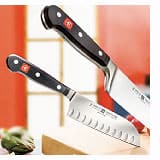
4. Wusthof
Since 1814, classic German looks and solid construction. Offering seven lines, including one endorsed by Emeril, there is a knife here for every taste and budget.
Chef's knives price range: $55 to $200
Image courtesy www.wusthof.ca
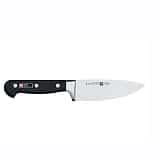
5. J.A. Henckels
Also from Germany, and also a classic choice. Offering several well-made lines, there are many different looks and price points to choose from.
Chef's knives price range: $130 to $450
Image courtesy https://usa.jahenckels.com
In the end, a good knife should:
• Deliver a smooth rocking motion when cutting.
• Feel great in the hand: nicely balanced, with a good heft to it.
• Be forged from high-quality, high-carbon, no-stain steel.
• Hold its cutting edge well for a long time, even in a busy kitchen.
• Never be made of stainless steel.
• Never go through the dishwasher.
• Always be stored in the sheath it came with, in a knife block, or on a wall-mounted magnetic strip, never loose in a drawer. It’s bad for the blade and dangerous for you and your family.
• Always make the cook very happy, and make short work of all your chopping and slicing.
Click below to learn how to properly steel a knife:
View more kitchen tips in our Test Kitchen Video Library >>
Page 2 of 2
Read more:
• Test Kitchen Videos: The best kitchen knives
• Smaller birds for a condo-sized, festive feast
• 10 culinary crimes no foodie should ever make
A good knife is also safer to work with than an inexpensive, lightweight, stainless steel job that will rapidly become dull and prone to slipping off foods, resulting in kitchen accidents.
But what makes a good knife? There are a few things to look for, and a few to avoid.
1. The blade
Just say no to stainless steel. Sure, these blades will keep their shine, but will soon lose their edge, and are too brittle to be sharpened. Once they're dull, you might as well throw them away. Look for high-carbon, no-stain steel. These knives will require some care: wash by hand—never run them through the dishwasher—and dry completely as they can rust. Take the time to sharpen them yourself, or have them sharpened by a professional now and then. Talk to your local kitchen supply shop, or inquire about sharpening where you purchased the knife, as many shops that sell knives also offer professional sharpening services.
2. The construction
The best knives boast only a two-part construction: blade and handle. That means, there are fewer, and in some cases, no parts to get loose, fall off, or come unglued. When looking at the knife, your eye should be able to follow the back of the blade, as the blade turns into the tang, uninterrupted, right to the end of the handle. In a poor quality knife, the blade may only extend a few inches into the handle, and will inevitably fall out… usually right in the middle of carving that holiday bird!
3. The handle
The handle is really a matter of personal taste and style. Here, the choices come down to earthy wood, sleek synthetic, bacteria-resistant plastic, grip-enhancing silicon, or one-piece, über-modern steel. But regardless of the material, a well-designed, ergonomic handle will just feel right when you pick it up.
What you really need
I think we’ve all stood baffled at the knife counter, and felt we had to buy one of everything on display. Not so. Knife sets are tempting and do make lovely gifts, but most cooks only need one really good knife for almost all kitchen jobs, and that’s the classic 8” to 10” chef’s knife.
Round out your knife collection with a pairing knife for delicate work, a good quality serrated knife for slicing bread and tomatoes, a steel for maintenance, and you’re good to go. (Watch how to properly steel a knife on page 2.)
However, there is a new kid in town, and his name is Santoku.
Page 1 of 2
Santoku: The latest and greatest kitchen knifeThe lovechild of a classic French chef’s knife and a Japanese cleaver, this all-purpose baby is rapidly becoming a favourite of home cooks and pros alike. It is smaller, more manageable, and well, it looks really cool! This newcomer features a distinctive shape, smaller size, and clever graton edge, or little dimples that run along the surface of the blade, encouraging sticky potato and cheese slices to slide off the blade.
Santoku knives are made by most major knife manufacturers, priced at about $50 and up.
Image courtesy https://calphalon.com
There are countless makers of quality knives on the market from many parts of the world, in many styles and at many different price points. Here’s a sampling of 5 brand-name chef's favourites:
1. Global
All steel, one-piece construction. With a masculine aesthetic, this Japanese line is very popular with the pros.
5.5" to 10' Chef's knife price range: $50 to $130
Image courtesy www.creativecookware.com
2. Chroma 301 Knives by PorscheForged from Japanese steel and designed by the legendary auto-maker F. A. Porsche, this all-steel, one-piece construction, offers a great blade, with a very sleek, high-end look and price tag to match.
10" Chef's knife price: $120
Image courtesy www.leevalley.com
3. Calphalon
Offering three lines: Katana VG Japanese steel, Contemporary, and their latest, the LX Series, all at very good prices. These great looking and well-made high-carbon German and Japanese steel knives are manufactured in China, thus keeping costs down.
Chef's knives price range: $40 to $112
Image courtesy https://calphalon.com
4. Wusthof
Since 1814, classic German looks and solid construction. Offering seven lines, including one endorsed by Emeril, there is a knife here for every taste and budget.
Chef's knives price range: $55 to $200
Image courtesy www.wusthof.ca
5. J.A. Henckels
Also from Germany, and also a classic choice. Offering several well-made lines, there are many different looks and price points to choose from.
Chef's knives price range: $130 to $450
Image courtesy https://usa.jahenckels.com
In the end, a good knife should:
• Deliver a smooth rocking motion when cutting.
• Feel great in the hand: nicely balanced, with a good heft to it.
• Be forged from high-quality, high-carbon, no-stain steel.
• Hold its cutting edge well for a long time, even in a busy kitchen.
• Never be made of stainless steel.
• Never go through the dishwasher.
• Always be stored in the sheath it came with, in a knife block, or on a wall-mounted magnetic strip, never loose in a drawer. It’s bad for the blade and dangerous for you and your family.
• Always make the cook very happy, and make short work of all your chopping and slicing.
Click below to learn how to properly steel a knife:
View more kitchen tips in our Test Kitchen Video Library >>
Page 2 of 2
Read more:
• Test Kitchen Videos: The best kitchen knives
• Smaller birds for a condo-sized, festive feast
• 10 culinary crimes no foodie should ever make





Comments