


Life & Relationships
Why You Should Make Friends Outside Your Age Group

Photo courtesy Seventyfour/Adobe Stock
Life & Relationships
Why You Should Make Friends Outside Your Age Group
In this age of loneliness, meaningful connections are more important than ever—so we may be selling ourselves short by only being friends with our peers.
In the recreation room of a Toronto retirement community, clusters of white-haired residents and young undergraduate students mingle about. They catch each other up on their weekends, ask about their friends and grandchildren, and swap stories that make entire sections of the room chuckle. The atmosphere is more jovial than any post-secondary class I’ve ever encountered—and they’ve only known each other for four sessions.
This is the home base of the University of Toronto’s Intergenerational Classroom, a course that pairs undergraduate students with retirement residents from Christie Gardens Apartments and Care in Toronto. Led by professor Raza Mirza, the class delves into the intricacies of aging, from ageism and care to Medical Assistance in Dying (MAID)—but there's another clear objective laid out for the students.
“Every year, Raza tells the students, ‘If you get one thing out of this course, I want you to make at least one friend,’” says Alexis Hart, a teaching assistant with the class. “We’ve been successful in exposing both students and residents to a whole new group of people that they wouldn’t have met otherwise.”

Alexis is one of many former students who made a lasting connection in the course. In true classroom fashion, she first met Christie resident Susanna Jacob while working on a group project together. Their school-focused conversation quickly spiralled from the assigned topic—ironically, social isolation and loneliness—to family, friends, and hobbies, like dance. By the end of their first chat, Susanna had invited Alexis to join her at a dance class. Their friendship blossomed into attending local shows together, grabbing coffee and dinner, and even trimming Susanna’s Christmas tree while sipping mugs of cider punch.
Alexis and Susanna are, simply, two people who enjoy each other’s company—arguably, the textbook definition of friendship. The biggest discernible difference between the pair? The five decades between them.
Loosely defined as platonic relationships between people born in different generations, intergenerational friendships can foster social inclusion and a sense of belonging. A 2021 study published in the journal Social Inclusion found that these relationships have the added benefit of promoting social welfare, cultivating new experiences, and breaking free of age-related stereotypes or expectations.
In practice, observing Susanna and Alexis interact is an experience that transcends age—they finish each other’s sentences, giggle at shared memories, and instinctively pause stories for the other to jump in.
We may be a few years out of the collective social isolation of the pandemic, but the ‘loneliness epidemic’ remains strong—more than one in 10 Canadians over 15 report always or often feeling lonely, according to a 2024 report from Statistics Canada. Connection is a pillar of our overall health; a lack of close relationships has implications ranging from depression and substance abuse to an increased risk of heart disease.
For most, meaningful relationships often arise through our peers. “People naturally gravitate toward those who are most similar to them,” says Zoë Francis, an associate professor in psychology at the University of the Fraser Valley in Abbotsford, B.C. We most often click with people that share common interests, from hobbies like chess and sports to shared cultural backgrounds.
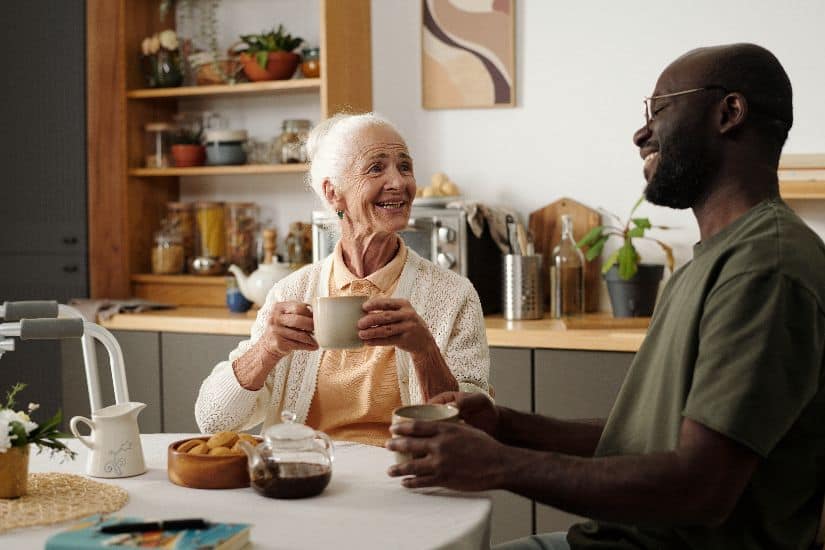
Photo courtesy Adobe Stock/pressmaster
But when an 80-year-old may be just as likely to enjoy pickleball as a 30-year-old, what are we missing out on by not connecting with those of different age groups? It turns out, quite a lot.
“For everyone, intergenerational friendships can help reduce ageism,” says Francis. “Research shows that, for older adults, these interactions are beneficial for mental health and well-being.”
Young people who have already had friendships with those senior to them—not including grandparents or other family members—are more likely to seek out these types of relationships. This mainly stems from an understanding, either explicit or intuitive, that intergenerational friendships are just as valuable as any other.
“You need both the motivation to befriend people who are of different ages, and the belief that there’s something valuable that those interactions could give you, but you also need the physical opportunity,” says Francis.
Being a part of a religious community is an easy way to foster these friendships. Volunteering is another. Recreational activities, like playing beer league hockey or signing up for a local crochet club, can also provide the opportunity to connect with people you might otherwise have never met or overlooked.
In talking about intergenerational friendships, you might envision a high school student earning volunteer hours at a nursing home and developing a relationship with an 80-year-old resident. While these friendships undoubtedly exist, they are also present between older adults.
Bestselling Canadian author Merilyn Simonds was in her late 40s when she met Beth, who was nearing 80 at the time. “Beth and I agree: It doesn’t matter how we met,” she writes in Walking with Beth, a reflective scrapbook of their friendship. “All that matters is that somehow, somewhere, our lives intersected. And we said to ourselves, ‘I want that woman as a friend.’”
As a child, Merilyn was drawn to the presence of older women, from neighbours to teachers. “Visiting my ‘old ladies’ when I was a girl was full of these moments where I got to be noticed and spoken to like a real person,” she says. “It always felt like an oasis of tranquility.” She brought them childlike joy and curiosity, and soaked up their stories of worldly travel and literature.
Even in the case of she and Beth—both with decades of experience and life lessons learned—these differences dance harmoniously in a way that enriches their friendship. “We are moving through the world in a slightly different way and yet in the same way,” she says. That said, age is by no means the pillar upon which the two stand.
It’s their shared love of art and history, everlasting curiosity, and commitment to showing up for each other that propels them forward. While there are certainly things to be learned from a friend who is your senior, gaining new perspectives from cross-generational friendships should be a two-way street that benefits both individuals.
The key is this: An intergenerational friendship is joyous, it’s fun, it’s tearful and, most importantly, it’s reciprocal.
In many ways, learning from one another is an inevitable part of intergenerational friendships. While plenty of life experiences are universal—one Christie resident told me she feels like she’s experienced every problem the undergraduate students have ever mentioned—there are just as many differences.
Some are generational—from climate change and politics to the unnervingly complex digital landscape of social media. Others, like cultural backgrounds and identities, are more personal. For Merilyn, it’s these differences that are intriguing. “Beth’s experiences aren’t my experiences,” she says. “She can’t tell me much about mine in particular, but she can tell me what it’s like to be a human moving through these various stages of life.”
In some ways, pathologizing friendship feels almost too zoomed out, too meta. Because, despite the lessons that these friends have inevitably taught each other, at its core, friendship is simple. As Alexis says about her relationship with Susanna, “We just get along.”


THE 5 CHARACTERISTICS OF A HUMBLE PERSON





Comments